The second edition of the NUHS Scientific and Innovation Summit underscores how data and genetic insight is transforming health, with launch of the National University Centre for Genomic Medicine a major transformative step in bringing genomics to clinical care
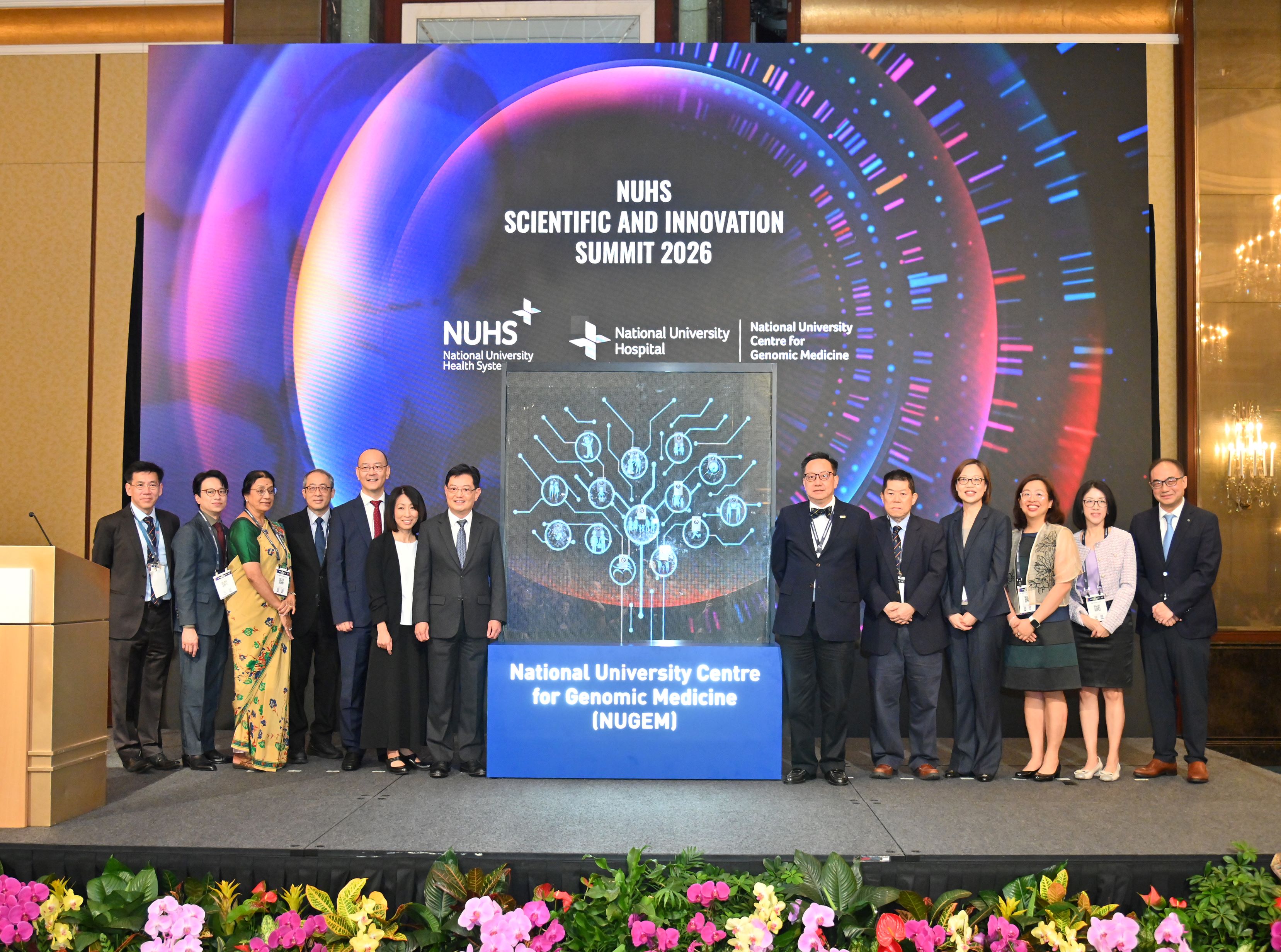
The launch of the National University Centre for Genomic Medicine (NUGEM) was officiated by Mr Heng Swee Keat, Chairman of the National Research Foundation, at the NUHS Scientific and Innovation Summit 2026. The new Centre marks a major step in NUHS’s effort to embed genomics into everyday care. Photo credit: NUHS
SINGAPORE — The National University Health System (NUHS) today showcased how advances in genomics, data science and digital health are accelerating Singapore’s shift towards predictive, personalised and precise healthcare at the cluster’s biennial Scientific and Innovation Summit.
The Summit brought together clinicians, scientists and healthcare leaders across various disciplines to demonstrate how health is being reimagined – by detecting health risks earlier, tailoring interventions more precisely, and ensuring safer, more effective care for patients and the population at large.
A key highlight of the Summit was the launch of the National University Centre for Genomic Medicine (NUGEM), marking a major step in NUHS’s effort to embed genomics into everyday care. This will strengthen early diagnosis, enabling tailored therapies, and ensuring safer, more precise prescribing across the health system.
“From public health experts modelling risk trajectories using population data across the life course, to digital health teams advancing digital‑first preventive care through wearables and real‑time monitoring, the Summit is highlighting how proactive, data‑driven insights are closing care gaps between hospital visits and enabling earlier action,” said Professor Roger Foo, Co-Chair of the NUHS Scientific and Innovation Summit Organising Committee.
Clinicians and scientists also showcased breakthroughs in reshaping precision diagnosis and treatment. Oral frailty studies, for example, are revealing how oral health signals systemic health and opens the door to personalised care. Pathogen genome sequencing research by infectious diseases experts also helps to uncover hidden transmission patterns and cut diagnostic time more than fivefold to just 24 hours, strengthening infection containment efforts. (Please see Annex A in the linked PDF for more information on the above projects.)
Bringing genomics into everyday care
Officiated by Mr Heng Swee Keat, Chairman of the National Research Foundation, the launch of the new Centre brings together NUHS’s expertise across different specialties such as oncology, cardiology, nephrology, ophthalmology, neurology, infectious diseases and more, expanding genomics testing beyond rare paediatric conditions.
Situated within the National University Hospital (NUH), NUGEM will be led by a multidisciplinary team comprising experts from NUH – including those from the National University Centre for Women and Children (NUWoC) – the Ng Teng Fong General Hospital (NTFGH), the Alexandra Hospital (AH), the National University Polyclinics (NUP), the National University Cancer Institute, Singapore (NCIS), the National University Heart Centre, Singapore (NUHCS), and researchers from the Yong Loo Lin School of Medicine, National University of Singapore (NUS Medicine).
Across NUHS, genomics testing is already supporting care across multiple settings, including primary care, prenatal care, intensive care units (ICUs), cancer treatment and rare disease diagnosis. Earlier genetic diagnosis will lead to personalised surveillance regimes, help avoid diagnostic odysseys and unnecessary investigations, and enable targeted treatments and proactive family screening, contributing to better outcomes for patients.
Supported by NUS researchers, new tests will be innovated so that patients who remain undiagnosed or have ambiguous genetic results can be clarified. This will bring new genomic tests to clinical labs, new insights into disease mechanisms, and identify potential new therapeutic targets.
“NUGEM is about transformation. It transforms the way we think about genomics in clinical care across the entire NUHS workforce, leveraging the strong foundations we have in digital and research ecosystems,” said Associate Professor Ng Kar Hui, Director of NUGEM.
“NUGEM is an enabler that brings genomics from the specialist pockets into routine care. This process will take time, but the first step is taken today: ensuring genomic insights occur where care happens, so decisions can be made faster, safer and more precise.”
Hope made tangible
At NUHS, genomics is already making a real difference in the lives of patients by supporting them through various critical and deeply personal decisions. Each story reflects how genetic insights can change a patient’s trajectory or offer clarity, certainty and hope when it matters most. (Please refer to “Genomics in action: Patient profiles” for more information on each case.)
- Life‑saving diagnosis and treatment in fulminant infection: Immunologic and genetic testing in the ICU uncovered a new immune defect affecting pathogen-killing in a young woman who was critically ill with a severe bacterial infection and had been non-responsive to conventional treatment over five weeks. The discovery enabled doctors to administer targeted immune-augmenting therapy that brought her off life support in days, and she has since recovered.
- Supporting patients across their life course: A newly married young woman diagnosed with neonatal diabetes as a baby underwent updated genetic testing to confirm the gene variant she carried, enabling her and her husband to undergo in-vitro fertilisation (IVF) with pre-implantation genetic testing (PGT‑M1). She welcomed a healthy baby girl in 2025.
- Uncovering a hidden risk: Genetic testing revealed a serious inherited kidney condition in an otherwise healthy mother after her first child was diagnosed at birth. With this knowledge, she was able to undergo IVF with PGT-M for her second pregnancy. She later welcomed a second child who does not carry the condition.
- Ending a diagnostic odyssey: After years without answers, new genetic testing technology may soon help a young man with suspected Alport syndrome – a hereditary kidney condition that can cause kidney failure and hearing loss – secure a definitive diagnosis. This will help guide treatment and clarify prognosis without the need for more unnecessary and painful tests, such as a kidney biopsy.
Making medicines safer
Another focus at NUHS is pharmacogenomics, which uses a patient’s genetic profile to guide medication choice and dosage, helping doctors to prescribe more safely and effectively. With over 99 per cent of local patients carrying variants that influence drug response, early identification of these variants can help doctors avoid adverse drug reactions and ensure patients receive medications that are most effective for them.
NUGEM plans to expand pre‑emptive pharmacogenomic panel testing so that genetic insights can inform prescribing decisions before treatment begins. More than 2,000 patients have undergone pharmacogenomics testing at NUHS, with plans to scale towards preventive, population‑level use.
Bringing better insights to the patients
Within the next two decades, it is estimated that one‑third of clinic encounters across NUHS may involve conversations around genomics or precision medicine. NUGEM is the bridge that transforms and conveys the genomic or precision medicine insights from research and Singapore’s National Precision Medicine Programme to the patients and families.
Beyond genomics, the Summit also highlighted NUHS’s broader ecosystem of innovation, spanning population health research, digital preventive care, antimicrobial stewardship, ageing science and precision diagnostics.
“Behind every project shared at the Summit is a patient whose life can be changed for the better. As we scale genomics and other emerging tools across our system, our goal remains simple: to give every person the right care at the right time, guided by the best possible insight,” said Associate Professor David Tan, Co-Chair of the NUHS Scientific and Innovation Summit Organising Committee.
To download the PDF version of the media release, click here.
1PGT-M refers to pre-implantation genetic testing for monogenic / single gene defects.