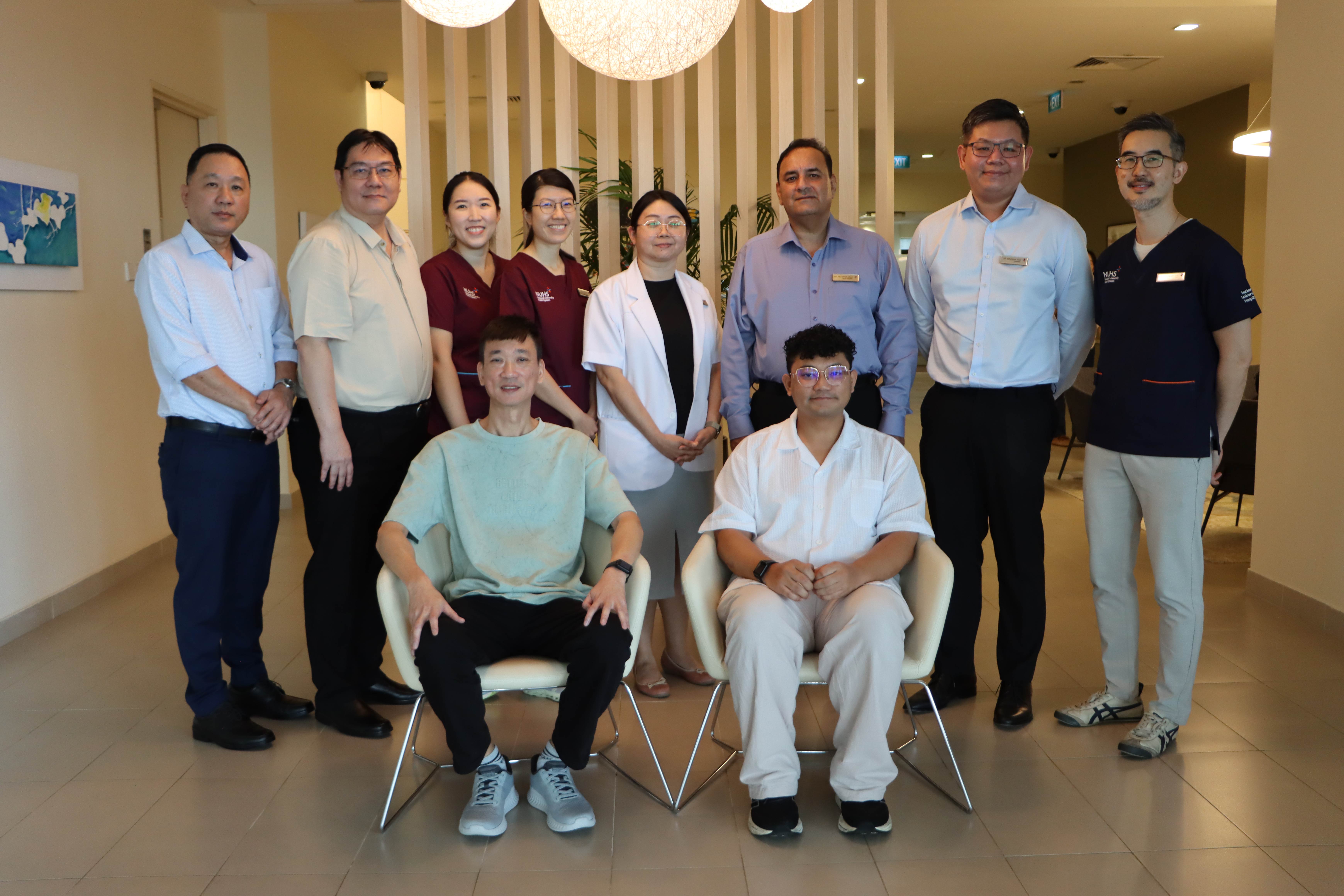
Photo credit: National University Hospital (NUH)
Patients Mr Chen Chye Song and Mr Nur Azhar Bin Hanafiah (seated, from left to right), with (standing, from left to right):- Mr Steven Tan, Human Resource Manager at Murata Electronics Singapore (Mr Chen’s workplace)
- Mr Quek Chun Siang, Department Manager, Murata Electronics Singapore
- Ms Wan Zhi Ying, Senior Physiotherapist, Department of Rehabilitation, NUH
- Ms Chen Zhenzhen, Senior Principal Occupational Therapist, Department of Rehabilitation, NUH
- Ms Magdalene Chia, Stroke Case Manager, Department of Medicine, NUH
- Adjunct Assistant Professor Aftab Ahmad, Head & Senior Consultant, Division of Neurology, Department of Medicine, Ng Teng Fong General Hospital (NTFGH)
- Adjunct Assistant Professor Benjamin Tan, Consultant, Division of Neurology, Department of Medicine, NUH
- Adjunct Associate Professor Leonard Yeo, Senior Consultant, Division of Neurology, Department of Medicine, NUH
The Early Supported Discharge Programme and Return To Work Clinic are among the hospital’s efforts to empower patients in regaining independence
SINGAPORE — While most young stroke survivors regain good physical function, many still struggle to return to work.
An international study led by researchers from the National University Health System (NUHS) analysed data from nearly 2,000 stroke survivors under the age of 50, and found that while more than 80 per cent of young stroke patients achieve good functional recovery, only about 60 per cent successfully returned to work.1
The research, which included patients from the National University Hospital (NUH) and Ng Teng Fong General Hospital (NTFGH), highlighted a critical gap between medical recovery and meaningful reintegration into daily life.
Lead researcher Adjunct Assistant Professor Benjamin Tan, who is also Consultant, Division of Neurology, Department of Medicine, NUH, explained: “We’re seeing a significant unmet need in stroke rehabilitation, considering the role work plays in the lives of this growing cohort of young stroke survivors.”
He added: “Work forms a key pillar of patients’ well‐being, identity and social participation. Every stroke patient deserves to have the right support in place to a full recovery. For younger stroke survivors, in particular, NUH’s vision is to make return to work a possibility for more patients.”
In younger patients, unemployment could mean years of lost income, which could translate to financial difficulties for patients and their dependents down the road.
A stroke survivor’s journey: “I wondered if I could ever work again”
For 54-year-old senior assistant engineer Mr Chen Chye Song, he knew something was amiss when he struggled to hold a piece of bread while having breakfast. Suspecting a stroke, his company doctor referred him to NUH, where Mr Chen received immediate medical treatment.
Less than a year later, he is back at the workplace, thanks to NUH’s Early Supported Discharge (ESD) Programme, where he underwent an intensive rehabilitation regime inclusive of home physiotherapy and occupational therapy over the course of one month.
Left with weakness and lack of coordination on his left side, the father of two wondered what his future would look like, and if he would ever be able to return to work. But just a week after his stroke, Mr Chen was discharged and enrolled into the ESD Programme.
Over the next month, a physiotherapist and an occupational therapist visited his home ten times for 45-minute sessions, where the physiotherapist focused on helping him improve muscle strength, balance and mobility through exercises and walking outdoors; the occupational therapist worked on improving his upper limb function through activities such as picking up coins.
As Mr Chen used to assist his wife in housework pre-stroke, the occupational therapy sessions also focused on helping him regain his daily function through common household chores. To help Mr Chen in his transition back to work, the occupational therapist encouraged him to practise work tasks such as typing and replying emails.
His wife supported his recovery, going on daily walks with him outside of the home therapy sessions.
Within three months, Mr Chen experienced significant improvement, particularly in the mobility of his left hand. He eventually returned to work with the support of his employer of ten years.
“I’m not as fast as before, but my colleagues’ patience has helped tremendously,” he shared.
Accelerating rehabilitation in the patient’s own home
The NUH ESD Programme enables selected suitable stroke patients who are medically fit and have adequate home support to be discharged early and continue intensive rehabilitation at home for up to three months.
Run by a multidisciplinary team comprising a neurologist, a physiotherapist and an occupational therapist, the team meets weekly to review patients’ progress.
Ms Chen Zhenzhen, Senior Principal Occupational Therapist in the Department of Rehabilitation, shared: “Post-stroke rehabilitation for patients and training of caregivers in the home and community setting helps patients regain functional skills and reintegrate into their lives more naturally.”
Ms Wan Zhi Ying, Senior Physiotherapist in the Department of Rehabilitation, added: “By enabling suitable stroke patients to be discharged early and continue intensive rehabilitation in a familiar setting, the NUH stroke team aims to build confidence and accelerate recovery. Home-based rehabilitation empowers patients to regain independence faster and reintegrate into their routines with greater ease.”
Since its launch in 2007, the programme has benefitted over 1,350 patients to date. From 2020 to 2025:
- Over 65 per cent of the patients who were employed or self-employed prior to their stroke were able to return to the same or modified job at the end of the ESD Programme.
- 66 per cent of the patients had no significant disability post-ESD, a significant increase from 15 per cent pre-ESD.
- About 50 per cent of patients returned to their everyday activities and were considered moderately active or very active, up from 8 per cent pre-ESD.
- 13-point rise in self-perceived health score. According to a patient-reported outcome measure, the average self-perceived overall health score across the patients improved from about 64 to 77 (out of a total score of 100, with 0 referring to the worst health and 100 referring to the best health one can imagine) at the end of the ESD programme.
Today, Mr Chen’s follow-ups have decreased from once every two months to twice a year. His life has largely returned to normal, and he continues with his daily walks to strengthen his muscle strength and mobility. His story is one of many showing that a stroke does not have to end a career, but can be the start of a comeback.
Closing the gap: Identifying patients at risk of workplace difficulties
As part of continued efforts to enable more survivors to return to work, NUH also started a dedicated Return To Work (RTW) Clinic in 2021. Led by a multidisciplinary team comprising neurologists, rehabilitation physicians, occupational therapists and stroke case managers, the clinic aims to address the gap of survivors who struggle to successfully return to work. The clinic has seen over 180 patients to date.
Ms Magdalene Chia, who is a Stroke Case Manager with the RTW Clinic at NUH, explained: “The team works on targeted rehabilitation plans that address not only physical, but also cognitive, psychological and social barriers that patients face. Occupational therapists tailor rehabilitation for job roles and daily routines, and stroke case managers focus on mood, confidence and other social challenges and needs.”
Notably, the RTW Clinic also adopts tools such as the Patient Health Questionnaire-9 (PHQ-9) for depression screening and the Montreal Cognitive Assessment (MoCA) to identify patients at risk of workplace difficulties early.2 A study led by NUHS researchers revealed that cognitive performance was a key determinant in returning to work. Patients with higher MoCA scores were significantly more likely to return to work within three months.3 Such tools allow for a systematic approach for early risk stratification, targeted intervention planning and coordinated care pathways that link acute care with vocational rehabilitation.
Holistic return-to-work efforts across the NUHS cluster is also strengthened through complementary services at NTFGH, which runs a multidisciplinary stroke clinic for all stroke patients since 2015. By combining evidence-based rehabilitation, cognitive screening and coordinated care pathways across entities, NUHS is committed to delivering a more resilient stroke care ecosystem, one that helps survivors return not just to health, but to meaningful life in society.
To download the PDF version of the media release, click here.
1Kwok, Gabriel Yi Ren et al. “Return to Work After Ischemic Stroke in Young Adults: A Multicenter Cohort Study, Systematic Review, and Meta-Analysis.” Journal of the American Heart Association vol. 14,8 (2025): e036427. doi:10.1161/JAHA.124.036427
2The PHQ-9 is a widely used tool comprising of nine questions for screening and assessing the severity of depression. The MoCA is a widely used 10-minute, 30-point screening tool for detecting cognitive impairment.
3Tan, Yong Yi et al. “Impact of early cognitive and psychological status on return to work after acute ischemic stroke.” Journal of the Neurological Sciences, Volume 481, 125730 (2026). doi:10.1016/j.jns.2026.125730