The main contractors awarded for the redevelopment of Alexandra Hospital are (i) a joint venture comprising Shimizu Corporation, Ssangyong Engineering & Construction Co. Ltd, and Kimly Construction Pte Ltd, and (ii) Rich Construction Company Pte Ltd.
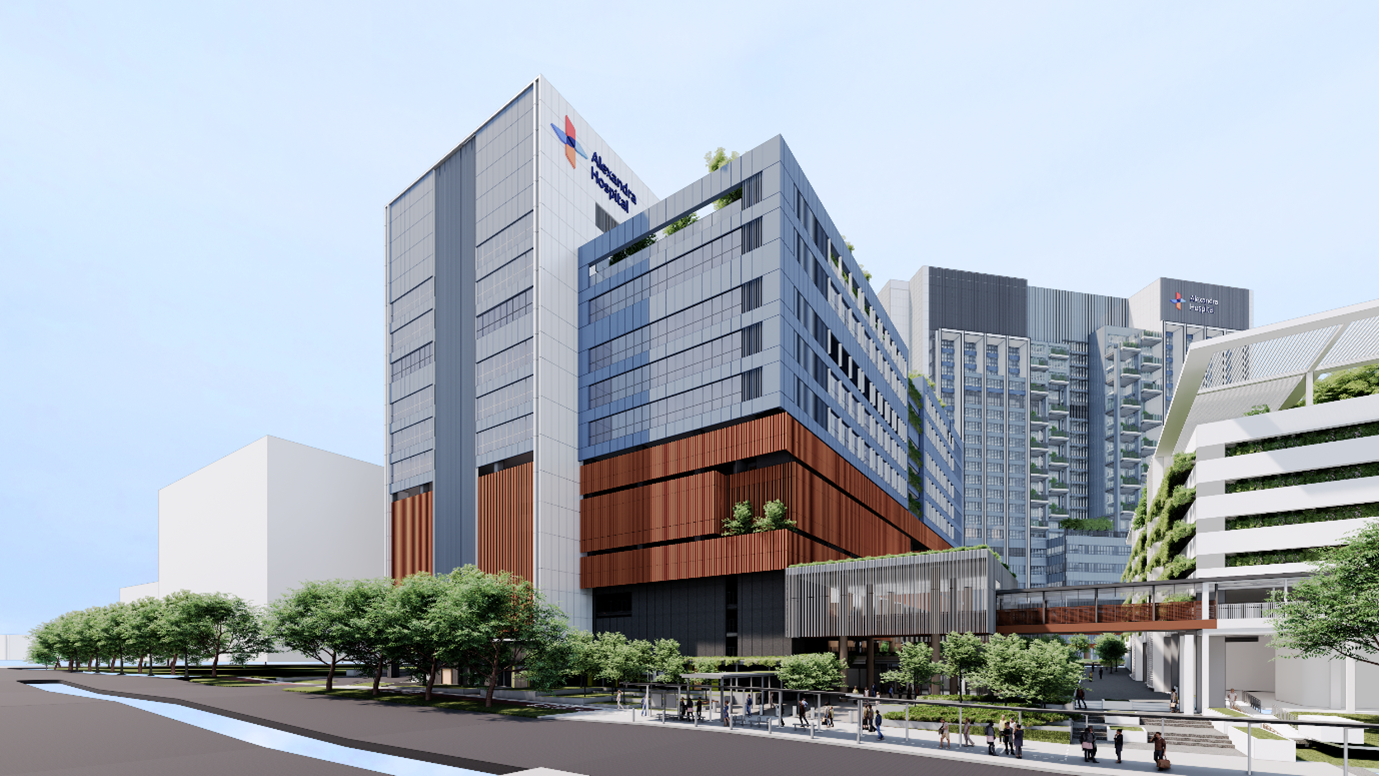
An artist’s impression of the redeveloped Alexandra Hospital
Singapore - Alexandra Hospital (AH) has embarked on the next major milestone in the redevelopment of its 13.3 hectares campus which comprises two towers for inpatient and outpatient facilities linked by a “community boulevard” bridge. Since its groundbreaking last year, AH has made steady progress with piling works successfully completed in July 2025. The redeveloped hospital is expected to open progressively in phases from 2028.
A member of the National University Health System (NUHS) and Singapore’s first integrated general hospital, the redeveloped AH is expected to have approximately 1,300 beds with a full range of clinical services and facilities and a pandemic-ready emergency department to serve the population of 1.1 million living in the southwest and west of the country. The hospital campus is co-located with a Nursing Home and is situated near the upcoming Community Care Apartments at Queenstown. Built next to the Rail Corridor, it will house signature programmes, with a focus on integrated medicine and the consolidation of care, ambulatory surgery, geriatric medicine and healthy ageing, rehabilitation and reablement, psychological medicine and mental health, supportive and palliative care, and the well population. It will be fully enabled by smart and virtual technology as well as artificial intelligence.
The two appointed main contractors are: (1) a joint venture comprising Shimizu Corporation, Ssangyong Engineering & Construction Co. Ltd, and Kimly Construction Pte Ltd; and (2) Rich Construction Company Pte Ltd.
Each contractor will be responsible for different zones within the redeveloped campus. This collaborative approach supports a phased construction strategy to allow for key hospital services to remain operational while work progresses. The selected contractors bring relevant experience in complex healthcare environments, with past projects including the National Cancer Centre Singapore, Yishun Community Hospital, Punggol Polyclinic, Changi General Hospital Medical Centre, among others. The scope of construction works will also include collaborating with appointed specialist vendors to ready medical equipment delivery and installation, and technology integrators to implement smart hospital systems.
Said Mr Eric Chua, Adviser to Queenstown Grassroots Organisations, “The redevelopment of AH into a comprehensive and integrated health campus will benefit the community, especially Queenstown which is expected to grow with new upcoming estates as well as age with nearly one in four residents aged 65% and above. I am heartened to see how the hospital’s vision aligns with our residents’ needs, and how heritage and innovation are coming together for a health campus that belongs to our people.”
Professor Yeoh Khay Guan, Chief Executive of NUHS, added, “The redevelopment of AH is a vital part of our long-term vision to support healthcare in the western region of Singapore. From the redevelopment of National University Hospital at Kent Ridge Campus to the planning of the future Tengah General and Community Hospital; and supported by the JurongHealth Campus and National University Polyclinics, our healthcare facilities across NUHS will enable seamless care journeys for patients across different stages of life and illness. Beyond clinical care, NUHS as an academic health system, is also committed to advancing medical knowledge. AH will shape future generations of healthcare workers in an environment that prioritises collaboration and continuous learning.”
Dr Jason Phua, Chief Executive Officer of AH, added, “It has been a challenging balancing act – redeveloping the campus while maintaining uninterrupted operations, co-designing the hospital of tomorrow while honouring the heritage of yesterday. I must acknowledge our staff for their inspiring dedication, our patients for their kind trust, and our partners in NUHS, the MOH Holdings, the Ministry of Health, the community, and beyond. Together, we are shaping a space that heals, inspires, and unites.”
-End-
Additional Information:
A Future-Ready Health Campus
Once completed, the new AH will span approximately 13.3 hectares, featuring two main towers:
- Inpatient Tower: a new Emergency Department, inpatient services, diagnostic and treatment areas, and approximately 1,300 beds.
- Outpatient Tower: outpatient clinics and services, supported by diagnostic imaging, pharmacy, and other clinical support functions.
The redeveloped campus will also include a co-located nursing home bringing together acute, rehabilitative, and long-term care within one integrated environment.
Building on the Integrated General Hospital (IGH) Model
With its Integrated General Hospital (IGH) model of care, which ensures a holistic and patient-centric care approach, every patient will be assigned a principal doctor to oversee and coordinate outpatient care. Duplication of services is reduced through thoughtful and deliberate planning of medical services and consolidation of care plans by the principal doctor, resulting in reduced clinic visits and care fragmentation while easing the burden on working caregivers.
The IGH care model is complemented by AH’s seven signature care programmes:
1. Well Programme
2. Integrated Medicine
3. Rehabilitation Medicine
4. Psychological Medicine
5. Healthy Ageing
6. Palliative and Supportive Care
7. Surgery and Anaesthesia
Patients will also benefit from NUHS@Home, an innovative "hospital-at-home" programme under NUHS for eligible patients to receive hospital-level medical care in a familiar environment.
Smart Care in a Connected Ecosystem
The redeveloped AH will operate within a connected ward ecosystem that leverages smart technologies such as contactless vital signs monitoring, telehealth cameras, and unified communication systems.
Central to this transformation is AH’s “Virtual Hospital” – a key enabler of the hospital’s Early Warning System (EWS) that supports early detection of patient deterioration and timely intervention. Real-time data integration across these technologies will reduce manual workloads, enhance patient safety, and empower patients in their recovery journey. Together with the “Virtual Campus”, which extends hospital-level care into the community, AH is building a seamless continuum of care across different settings. In addition, through its dedicated “Living Lab”, the hospital will continue to prototype, test, and refine innovations that drive proactive, coordinated, and efficient care delivery.
Future-Ready, Designed for Resilience
With lessons learnt from the COVID-19 pandemic, AH’s new infrastructure is built to be pandemic-ready with zoned layouts for infection control, negative pressure rooms, dedicated pathways for patient transfers, and isolation lifts to transfer infectious patients from the Emergency Department directly to the isolation wards.
Recognising the essential role of caregivers, the new campus will also include rest and recharge spaces, enhancing caregiver support and well-being.
Improved linkways and direct access to the surrounding Queenstown community will ensure better integration between the hospital, nursing home, and neighbourhood.
Phased Approach for Progressive Ramp-Up and Recruitment
AH will implement a phased approach to ensure workforce readiness and sustainability. Under this model, services and operations will be scaled up incrementally with infrastructure readiness. This deliberate and measured ramp-up will allow teams to pilot workflows, fine-tune clinical processes, and adapt to evolving needs as the hospital expands.
This will also support the hospital’s recruitment strategy with a structured timeline for recruitment, onboarding, and training of new staff. By aligning workforce expansion with the pace of physical development, new hires will be able to integrate into the hospital’s culture and systems, empowering a professional and compassionate workforce while reinforcing the hospital’s commitment to delivering safe, patient-centred care from day one.
Sustainability, Preserving Heritage and Healing Spaces
The transformation is deeply rooted in sustainability and respect for its rich history. As part of the NUHS Green Plan, the campus is aiming for Green Mark Super Low Energy certification, featuring renewable energy strategies such as solar panels, eco-friendly water heating and biophilic designs to support healing and rehabilitation.
Heritage buildings gazetted for conservation will be preserved and thoughtfully integrated into the modern campus. An online heritage gallery, a commemorative coffee table book, and future plans for a physical heritage gallery and self-guided heritage tours will honour AH’s close-to-a-decade-long (87 years as of 2025) legacy.
To download the PDF version of the press release, click here