From redesigned surgical trays to operating theatre concepts informing future hospitals, the collaboration translates design interventions into practical, system-level impact through deep research fieldwork
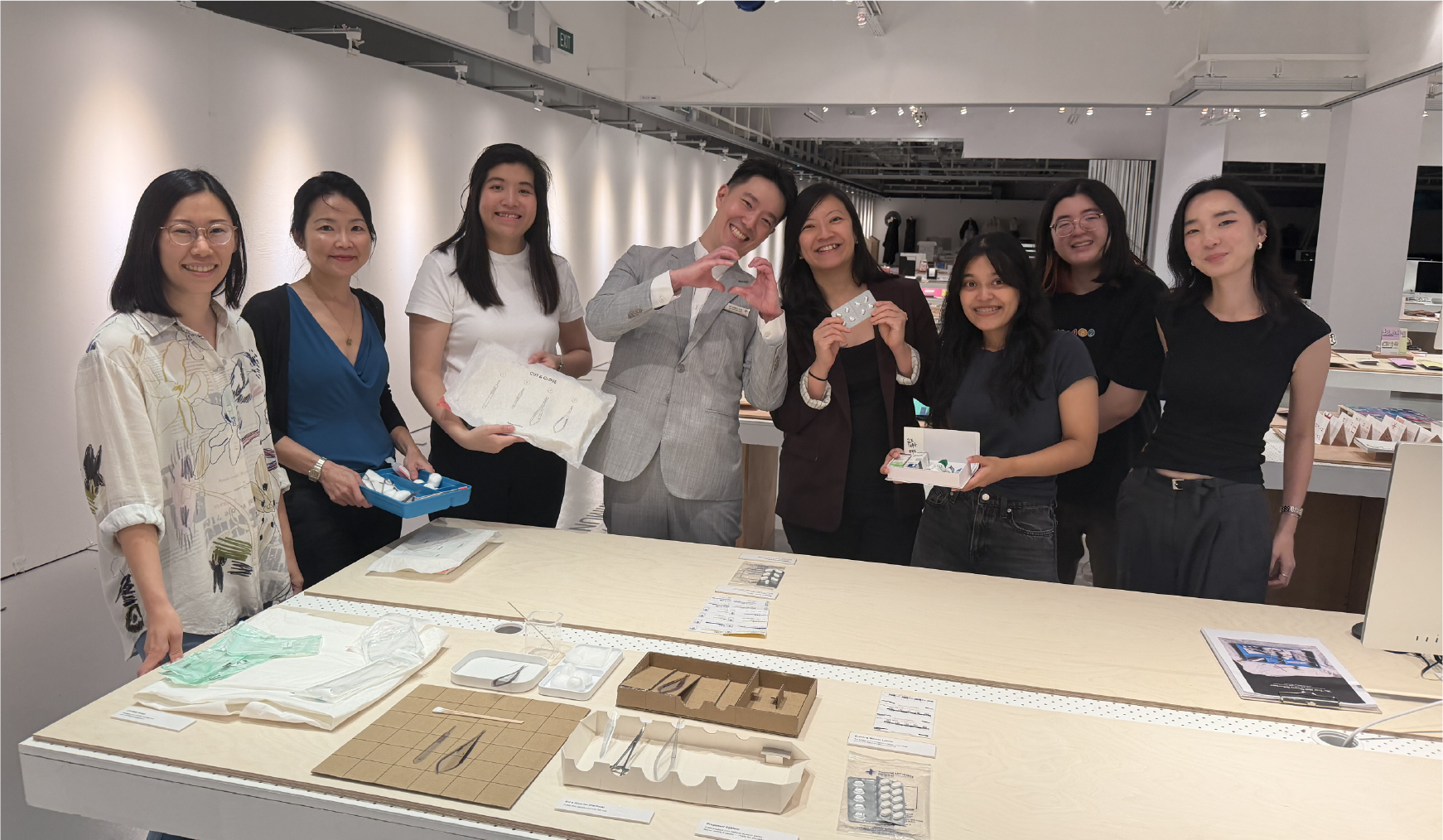
From left to right: Ms Wendy Chua (Programme leader, BA (Hons) Design for Social Futures LASALLE), Ms Audrey Tan (NUHS Sustainability Office), Ms Tan Yee Jing, Dr Chris Lim (NUH), Dr Blanche Lim (NUH), Ms Inda Kiranthie, Ms Delia Lee, Ms Cheong Wen Xuan at the LASALLE Show Exhibition 2026 highlighting the design projects borne from the Sustainable Medicine Design Lab. (Photo Credit: National University Health System)
SINGAPORE — The National University Hospital (NUH) and LASALLE College of the Arts, University of the Arts Singapore (LASALLE) have established a first-of-its-kind Sustainable Medicine Design Lab, bringing together clinicians, designers and students to develop design interventions for more sustainable healthcare systems.
The interdisciplinary design research lab was conceived by LASALLE’s BA (Hons) Design for Social Futures programme, in partnership with the Department of Ophthalmology at NUH and the Office of Sustainability at the National University Health System (NUHS).
From the inaugural lab, six projects by final-year LASALLE students were developed through a year of immersive research, fieldwork and ethnography with diverse stakeholders.
Rooted in deep design anthropology, the students' work unpack highly complex issues by applying critical system thinking, direct observation, and hands-on practice. Together, the projects address sustainability across clinical workflows, infrastructure, patient experience and system behaviour. Notably, several of these projects are already under review for real-world implementation. The projects include:
- Redesigning the Cataract Operating Theatre by Bridget Lim: A future-ready operating theatre model integrating workflow efficiency, ergonomics and sustainability principles. The concept offers valuable feedback to ongoing planning efforts and builds on considerations being undertaken to inform the design of upcoming healthcare developments.
- Rethinking the Procedure Tray by Tan Yee Jing: A redesigned surgical tray that supports procedural flow, reduces cognitive load during operations, and minimises material waste. The concept is being explored for further development with clinical and industry partners, with potential for adoption beyond ophthalmology.
- Reducing Pharmaceutical Waste by Inda Kiranthie: Targeted interventions to address inefficiencies in prescribing and dispensing practices, supporting more sustainable medication use without compromising patient care.
- Humanising the Clinic by Cheong Wen Xuan: A practical toolkit to embed empathy and social sustainability into clinical environments, enhancing patient experience while supporting care teams.
- Patient Eye Health Literacy by Delia Lee: Design-led interventions to improve patient understanding and engagement, enabling more informed decision-making and better long-term outcomes.
- Addressing Chronic Misalignment by Elijah Chia: An exploration of why behavioural sustainability initiatives often fail to gain traction in healthcare settings, with recommendations to better align systems, incentives and day-to-day clinical practice.
The lab marks a shift towards design-led innovation grounded in real clinical environments, where strategies and interventions solutions are conceived by students and co-developed with diverse stakeholders on the ground for direct applicability to healthcare operations. It marks the biggest collaboration to date between the healthcare sector and an arts institution in terms of the scale and depth of research.
Associate Professor Victor Koh, Head & Senior Consultant, Department of Ophthalmology, NUH, said: “This collaboration allows us to bring design thinking directly into the clinical setting, and to translate ideas into solutions that can be implemented. By working alongside designers, we are able to examine our workflows and environments in new ways. This opens up opportunities to improve efficiency, reduce waste and ultimately enhance patient care.”
Ms Nur Hidayah, Dean, Faculty of Design at LASALLE said: “Our close collaboration with NUH demonstrates how design can contribute meaningfully to complex systems in non-design sectors such as healthcare. By bringing in clinicians to mentor our students alongside design lecturers, our students have been able to develop interventions that are both imaginative and actionable, making a tangible real-world impact at the intersection of fields.”
LASALLE’s BA (Hons) Design for Social Futures programme was introduced in 2024 as Singapore’s first design undergraduate programme intentionally focused on nurturing designers to work in non-design sectors. The students, who are from the programme’s first graduating cohort, worked side-by-side with clinicians and designers to co-develop solutions grounded in real-world healthcare environments. The six projects will be exhibited at LASALLE’s McNally Campus from 22 May to 3 June 2026 as part of The LASALLE Show Exhibition 2026, the institution's annual graduation showcase.
About the Sustainable Medicine Design Lab
The Sustainable Medicine Design Lab represents a powerful alignment between NUH and LASALLE, demonstrating how cross-sector collaboration can push beyond traditional medical and academic boundaries. Together, the two institutions are utilising this platform to:
- Advance sustainable healthcare practices through human-centric system redesign
- Drive workplace transformation in response to growing healthcare demands
- Attract and nurture a new generation of interdisciplinary talent, bridging the gap between clinical application and design innovation
As global healthcare systems confront rising demand and mounting environmental and operational pressures, this joint approach serves as a blueprint for future models of care.
Ultimately, NUH and LASALLE envision the Sustainable Medicine Design Lab as an ongoing incubator for healthcare design. By empowering successive cohorts of students to co-develop interventions in real-world settings, this cultivates a sustainable pipeline of innovation, ensuring that new products, workflows, and system-level strategies are continuously tested, refined, and deployed on the frontlines of care.
The inaugural lab is spearheaded by Mr Low Cheaw Hwei, Dr Chris Lim (Consultant, Department of Ophthalmology, NUH), Dr Blanche Lim (Consultant, Department of Ophthalmology, NUH)1, Ms Wendy Chua (Programme Leader, BA (Hons) Design for Social Futures, LASALLE) and Mr Justin Zhuang (design writer and researcher).
The programme begins with a three-month internship where students familarise themselves with the healthcare environment, followed by nine months of intensive fieldwork. During this time, students observe medical procedures and facilitate co-design sessions with diverse groups.
The one-year mentorship engaged a wide array of participants: patients and caregivers; clinical staff such as doctors, nurses, and pharmacists; and essential operations personnel including management, cleaners, and the logistics teams responsible for sterilising surgical equipment.
To download the PDF version of the media release, click here.
1 Dr Chris Lim and Dr Blanche Lim are also adjunct lecturers for LASALLE’s BA (Hons) Design for Social Futures programme, marking the first time where design students in an arts institution are taught by medical professionals.